Enter: Aphrodisiacs
Love, lore, and stuffed dates

Greetings, dear subscriber. Apologies for my absence the past couple weeks — evidently, all that nail-biting and nose ring-adjusting and city-living and not-actually-believing-the-flu-shot-does-anything-or-is-necessary-ing caught up to me and knocked me down, hard, for about five days. That week was immediately followed by an amazing few days in the mountains celebrating some best friends. Getting back into publishing weekly now!
✧˖°⊹ ࣪ ˖ ࣪ ˖✧・*:.。. .。.:*・゜゚・*☆˖°⊹ ࣪ ˖✧`✦ ˑ ִֶ 𓂃⊹ ˖✧˖°⊹ ࣪ ˖☾ ⋆*・゚:⋆*・゚:⠀ *⋆.*:・゚ .: ⋆*
What do pomegranates and Viagra have in common? Both contain polyphenols, a powerful antioxidant that prevents the disease, and… you know the rest.
This month, we will explore aphrodisiacs, substances attributed to heightening libidos. Aphrodisiac presence is far-reaching, from antiquity to neurochemistry. Their origins are a patchwork of folklore, mythology, and scientific discovery. Though their rumored provocative properties are largely unfounded, many odd substances have been thrust into the cannon — consider oysters, bird nest soup, piranhas, or sparrow tongue.
In some cases, the Law of Similarities is at play. It states, rather reductively, that like causes like, arguing that things like sea cucumbers and ginseng increase desire because they are suggestively shaped or textured. Others, like maca root, are backed by science.
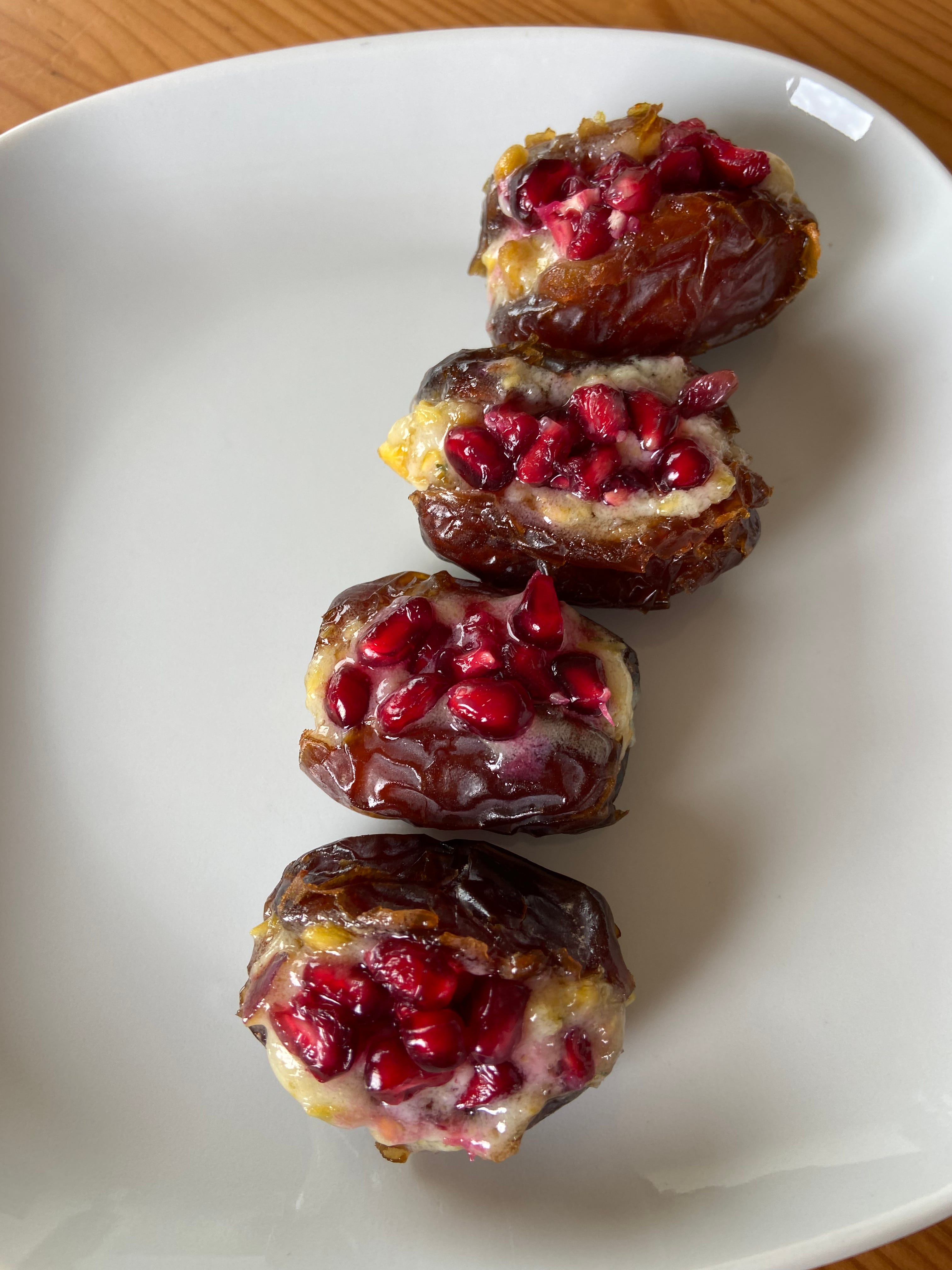
But before we get into that — come, let us dine like the Hellenics. We’re making finger food: Mascarpone-filled dates with pistachio and pomegranate. You’ll need…
4 ounces of mascarpone cheese
1 tablespoon of honey
1/2 teaspoon of orange zest (if you have an orange lying around)
1 tablespoon pistachios, raw or roasted, but definitely salted
dozen and a half or so Medjool dates, pitted
half a pomegranate worth of seeds
Preheat the oven to 375. Pit the dates, leaving one side intact so you can fill them. In a bowl, mix the mascarpone, honey, zest, pistachios, and salt until combined and smooth. Using a small spoon, stuff the dates with the mascarpone mixture. Then, place them on a plate and freeze for 10 minutes. (This is so the stuffing doesn’t melt in the oven.) Alternatively, you can skip the whole oven step and just serve them cold. They’re good either way. Cooking them makes the dates mushier and more caramelly.
Pomegranate’s inclusion as an aphrodisiac is backed by both lore and scientific logic. Few fruits are so richly endowed with symbolism: Buddhism, Christianity, Hinduism, and Islam all view the pomegranate as a meditation between life and death. Moreover, as one of the most important Eurasian medicinal plants, the pomegranate represented eternity to people as far afield — temporally and geographically — as the Babylonians to the Christian Europeans. Pomegranate is not just a merger of life and death, but of cultures and kingdoms.
Pomegranate’s reputation as an aphrodisiac is centuries in the making. In the Ancient Greek myth of Persephone, she eats pomegranate seeds given to her by the ruler of the Underworld, Pluto. Persephone returns to Earth, bringing spring and summer with her, but the pomegranate seeds madden her with desire. She then leaves Earth for half of every year to return to Pluto, leaving the Earth to suffer in autumn and winter in her absence.
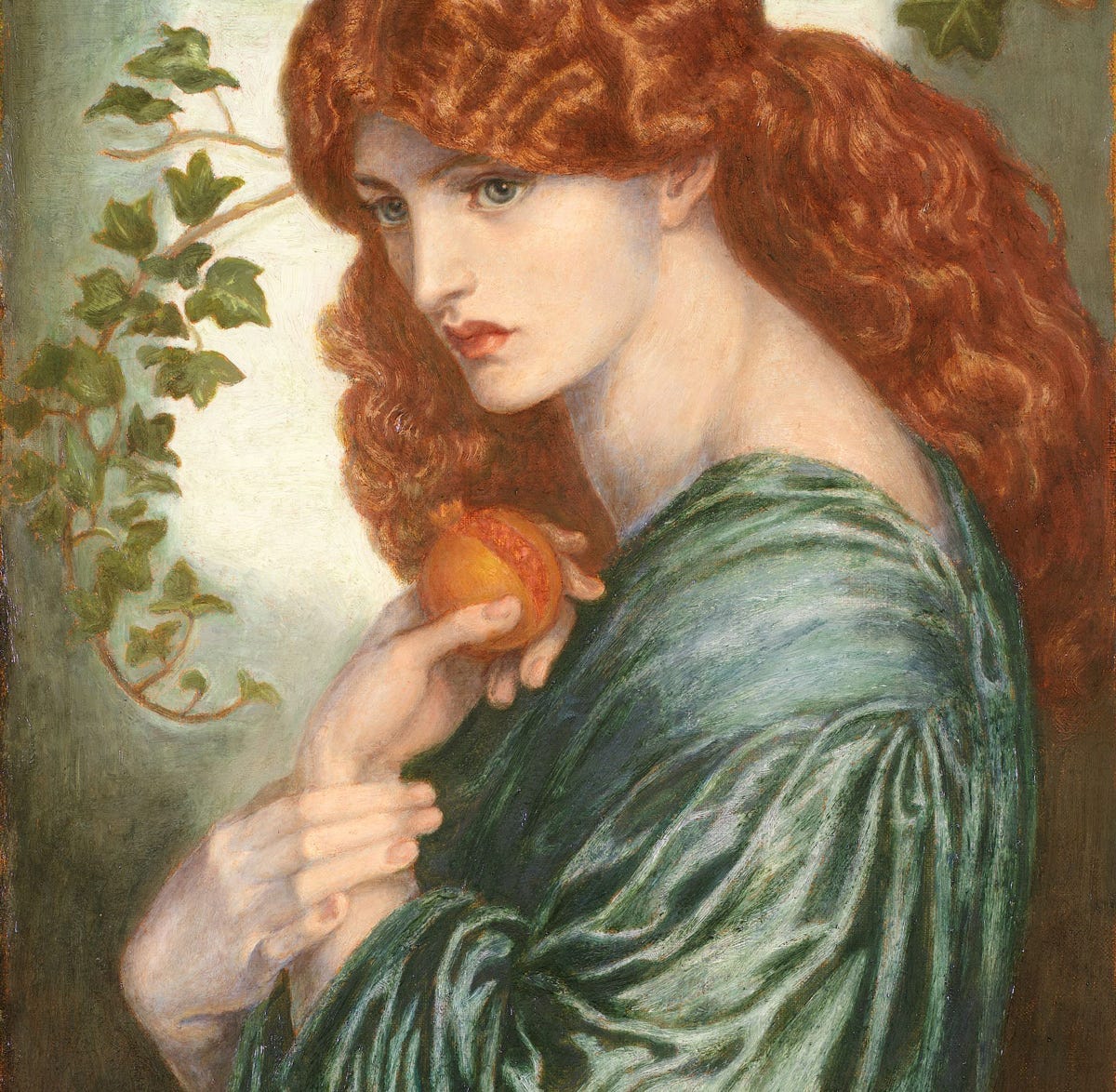
Two thousand years later, a nightingale sings in a pomegranate tree outside Juliet’s window as she awaits her dear Romeo.
Juliet. Wilt thou be gone? it is not yet near day:
It was the nightingale, and not the lark,
That pierc'd the fearful hollow of thine ear;
Nightly she sings on yond pomegranate-tree:
Believe me, love, it was the nightingale.
To add to its balancing act, pomegranate was used not only as an aphrodisiac but also as a contraceptive. The rind was topically applied for men or in suppositories for women. (Don’t try this at home).
It symbolized both fertility and barrenness, “serving to govern the transition from one part of the dyad to the other,” writes historian A.R. Ruis. It was believed to cause both the “loss of virginity” and the “restoration” of it. Ruis noted a twelfth-century Latin compendium of women’s cosmetics and medicine, which contains the recipe for a powder including pomegranate rind, presumably for its coloring, that could be used to create the illusion of a hymen.
People of the Mediterranean and Middle Eastern regions associated it with several goddesses, including Inanna, Mesopotamian goddess of love, fertility and warfare; Tanit, Carthage goddess of fertility and the moon; Rhea, Greek goddess of motherhood, fertility, comfort and good living; and of course, Aphrodite, the Olympian goddess of love, beauty, pleasure and procreation and the namesake of aphrodisiacs. She is credited with planting the first pomegranate tree.
Muhtasibs — Islamic leaders — prohibited the sale of pomegranates near mosques because they believed the fruit incited people to act up (pun intended).
It’s not all lore. A small study by Queen Margaret University found that drinking pomegranate juice daily lowered cortisol levels, corresponding with increased testosterone levels in both men and women. Modern science has also found that chemicals in pomegranate are all the good anti’s: antitherogenic, antibiotic, anti-carcinogenic, antihypertensive, anti-inflammatory, and antioxidant. They’re also astringent, estrogenic, and spermatogenic.
Dates and pistachios are also aphrodisiacs, though less revered than the pomegranate. Dates are high in amino acids, which are known to increase sexual stamina and are a popular aphrodisiac in North African nations. A daily handful of pistachios has been studied and attributed to decreased erectile dysfunction.
That 10-ish minutes should be up by now! Place the dates on a baking sheet and bake for 3-4 minutes, just until the dates are warmed through. Press pomegranate seeds into the mixture when they’re done and halfway cooled. Serve asap! Feed your friends! Bask in the light of an eternal spring! The groundhog did not see his shadow!